|
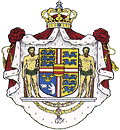
Danish Monarchy, the most historical of the World
The Danish monarchy is a unique institution. An unbroken royal line
of fifty kings and two queens is actually a world record. More than
a thousand years ago, King Harald founded the kingdom of Denmark. And
even though not all the Danish kings have by any means been world champions,
the Danish monarchy throughout its thousandyear history, from the
Viking kings to the modern constitutional monarchy, has had an almost
mythic ability to adapt to the social and political changes of the centuries.
In many ways it has been the Crown that has preserved this small country
at the tip of the European continent through wars, revolutions, reformations,
and foreign occupation.
It was the Crown that held the realm together. It was, and is, in the
purely personal relationship between the individual monarch and the
people that kingship has its roots in Denmark. Historians have pointed
out that kingship can survive only when the holder of the office becomes
the peculiar embodiment of the qualitie which the people regard as characteristic
of themselves. That is to say, when in their king or queen the people
recognize themselves.
The Queen Margrethe II
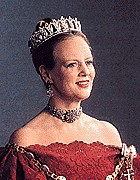 Margrethe
Alexandrine Torhildur Ingrid, daughter of King Frederik IX (18991972)
and Queen Ingrid (born in Sweden in 1910) was born on 16 April 1940,
the eldest daughter of the popular Crown Prince and his consort, as
they were then. The Germans were in the country. On 9 April Hitler's
troops had attacked and invaded defenceless Denmark, and the birth of
the little princess acquired a symbolic value as a ray of hope in a
time of darkness. Margrethe
Alexandrine Torhildur Ingrid, daughter of King Frederik IX (18991972)
and Queen Ingrid (born in Sweden in 1910) was born on 16 April 1940,
the eldest daughter of the popular Crown Prince and his consort, as
they were then. The Germans were in the country. On 9 April Hitler's
troops had attacked and invaded defenceless Denmark, and the birth of
the little princess acquired a symbolic value as a ray of hope in a
time of darkness.
She is the first queen regnant of Denmark. Her predecessor and namesake,
Margrethe I (13531412) ruled on behalf of her son Oluf. Margrethe II
is also the first genuine creative artist to sit on the Danish throne.
The very fact that a reigning queen is even willing to embark on interviews
with leading, sometimes controversial, Danish artists and intellectuals
without any censorship before or after, is an indication that this is
a woman who is unique, something special, not just by her position,
but also because she has broken free of some of the restrictions that
might have been her destiny.
Time and again Queen Margrethe has emphasized that first and foremost
she is Queen, Head of State. That is her heritage, her job, her duty.
But it is as an active artist that the Danes have come to know this
intelligent, sensitive, and unorthodox female (as another wellknown
Danish author has called her) as a living and vibrant human being.
The Danes were introduced to a deeply moved young woman when, on 15
January 1972, the 31yearold heir presumptive stepped out onto the
balcony of Christiansborg Castle, where the then prime minister Jens
Otto Krag proclaimed her the new Queen of Denmark. The previous day
she had lost her father, whom she loved dearly: King Frederik IX is
dead! Long live Her Majesty Queen Margrethe II. In the midst of her
grief she had to take the reins: And could I do it so that people need
not be ashamed of me?
The Prince Henrik
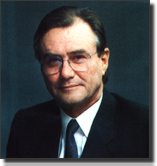 It
was not easy for the French diplomat Henri Marie Jean André, Count de
Laborde de Monpezat (born 11 June 1934) when on 3 September 1966 he
had to hurry from London to Copenhagen to be introduced as the fiancé
of the heir to the Danish throne. The news of the secret betrothal had
leaked out and the Danes were unprepared for there being a man in the
princess life. It
was not easy for the French diplomat Henri Marie Jean André, Count de
Laborde de Monpezat (born 11 June 1934) when on 3 September 1966 he
had to hurry from London to Copenhagen to be introduced as the fiancé
of the heir to the Danish throne. The news of the secret betrothal had
leaked out and the Danes were unprepared for there being a man in the
princess life.
The couple met in London, where he was a secretary at the French embassy.
Later, the Queen was to confess that it was love at first sight, that
the sky exploded.
They were married on 10 June 1967 at a ceremony in Copenhagen which
was a national celebration. At the same time the young French count
had to change his name (to Prince Henrik), his nationality, his religion,
his language, and his job. That was hard. Maybe Prince Henrik felt a
little lost in Denmark in those first years. But to the Danes now Prince
Henrik has become one of themselves. He is not just the Queen's charming
companion. In his own right Prince Henrik is highly respected for the
work he does for the country that has become his own.
The Crown Prince Frederik
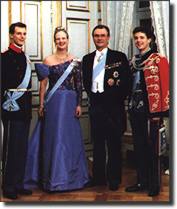 The
Crown Prince of Denmark (born 26 May 1968) will be the first Danish
king with a university degree. On completing his studies in political
science and constitutional law at the University of Århus, Crown Prince
Frederik can add the letters a Master's Degree in Political Science
(M.Sc.) to the titles he was born with. This tells us something not
only about the Prince's abilities and ambitions, but also about the
demands that will be made upon a future head of state in an ancient
monarchy, where the monarch does not sit purely symbolically at the
head of the table in the Council of State, but where the survival of
kingship has been placed in the hands of the personality who is expected
both to preserve and to renew the tradition. The
Crown Prince of Denmark (born 26 May 1968) will be the first Danish
king with a university degree. On completing his studies in political
science and constitutional law at the University of Århus, Crown Prince
Frederik can add the letters a Master's Degree in Political Science
(M.Sc.) to the titles he was born with. This tells us something not
only about the Prince's abilities and ambitions, but also about the
demands that will be made upon a future head of state in an ancient
monarchy, where the monarch does not sit purely symbolically at the
head of the table in the Council of State, but where the survival of
kingship has been placed in the hands of the personality who is expected
both to preserve and to renew the tradition.
He have a brother, The Prince Joachim (born 7 June 1969).
Engagement announce
The Queen Margrethe II has given the green light for the engagement
of Crown Prince Frederik to Australian lawyer Mary Donaldson, the royal
palace announced October 8, 2003.
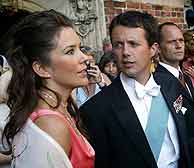
Prince Frederik, 35, the elder of the queen's two sons, met the 31-year-old
Australian during the 2000 Sydney Olympics.
The couple have been making joint public appearances for over a year,
going to weddings, parties and on holidays together.
Under the Danish constitution, government and parliament must approve
the marriage of the descendants of the throne.
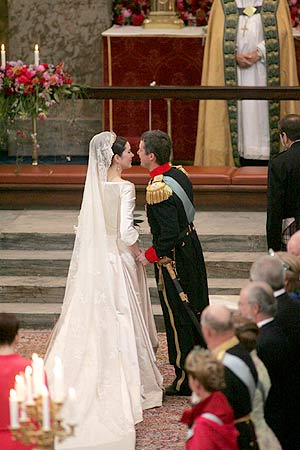 Denmark's Crown Prince Frederik has married his Australian fiancee Mary Elizabeth Donaldson in Copenhagen May 14, 2004. Denmark's Crown Prince Frederik has married his Australian fiancee Mary Elizabeth Donaldson in Copenhagen May 14, 2004.
Thousands of flag-waving well-wishers lined the streets of the city, with a heavy police presence around the city's cathedral where the ceremony was held.
The couple, the prince in full military colours, his bride in a simple ivory dress, with train and bridal veil, left in an open horse-drawn carriage.
She becomes Australia's first European princess in a reigning monarchy.
Royals and dignitaries from around the world were at the Vor Frue Kirke cathedral for the ceremony.
Ms Donaldson, accompanied by her father, walked up the aisle carrying a bouquet of white roses with stephanotis highlights and Australian eucalyptus with berries.
Her veil was made from 100-year-old Irish lace.
Prince Frederik, 35, in a formal Danish naval uniform, was visibly moved by the occasion, wiping away tears as he smiled, waiting for his bride.
'Fairy tale'
Bishop of Copenhagen Erik Svendsen, who married the couple, said in his sermon that "nothing in the real world is as uncomplicated as in the fairy tales".
And there was no "You may kiss the bride" after they had exchanged vows. But the bride did give her prince a kiss on the cheek as they were driven through the streets in the carriage, promoting applause from the crowd.
Denmark has been celebrating the wedding in Copenhagen, which has been bedecked with Danish and Australian flags, while portraits of the couple are hanging in shop windows.
One well-wisher, Annie Jensen said: "She is good for Frederik and good for the people.
"She will represent Denmark and sell us abroad, working for us just like Queen Margrethe and Prince Henrik."
Crowds on the streets outside the cathedral were able to watch the ceremony on large screens.
The couple met when the 35-year-old crown prince attended the 2000 Sydney Olympics.
In a tale redolent of Denmark's famous storyteller Hans Christian Anderson, Ms Donaldson said she was unaware of his royal status at the time.
"I guess you could say it's a modern fairy tale," she told Denmark's Politiken newspaper in an interview this week.
Family tradition
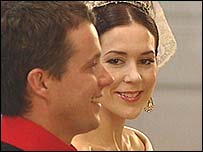
Ms Donaldson comes from the island of Tasmania. Her father is a maths professor and her stepmother is British author Susan Moody. Her natural mother died in 1997.
In order to marry the crown prince, she has had to give up her Australian and British citizenship and convert to the Lutheran Church.
Crown Prince Frederik, the heir to the throne, is following what is becoming a family tradition by choosing a foreign spouse.
His younger brother Joachim is already married to a Hong-Kong born Briton.
Queen Margrethe herself married a Frenchman - diplomat Count Henri la Laborde de Monpezat, who later became Prince Henrik.
Many Danish people remain strong supporters of the monarchy, and Crown Prince Frederik has wide popularity.

|