History
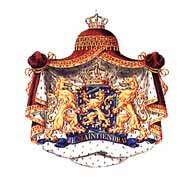
The Netherlands is a monarchy since 1815. The Royal House is the House
of Orange.
The history of The Netherlands an independent state dates back to the
1568, when the absolutist aspirations of the sovereign lord, the Catholic
King Philip II of Spain, and his measures to suppress freedom of religion
led a number of the provinces of the northern Netherlands to rise up
in revolt under the leadership of Prince William of Orange.
The Queen Beatrix
 Princess
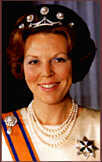
Beatrix of the Netherlands was born on 31 January 1938, the first child
of Princess Juliana and Prince Bernhard. The Princess was born at Soestdijk
Palace in Baarn, where she lived until May 1940, when, on the German
invasion of the Netherlands, the family left for the United Kingdom.
From there, Princess Beatrix and her younger sister Irene, who was born
in 1939, moved with their mother to Ottawa in Canada. It was not until
five years later, on 2 August 1945, that the family, with the third
child, Margriet, born in Canada in 1943, again set foot on Dutch soil. Princess
Beatrix of the Netherlands was born on 31 January 1938, the first child
of Princess Juliana and Prince Bernhard. The Princess was born at Soestdijk
Palace in Baarn, where she lived until May 1940, when, on the German
invasion of the Netherlands, the family left for the United Kingdom.
From there, Princess Beatrix and her younger sister Irene, who was born
in 1939, moved with their mother to Ottawa in Canada. It was not until
five years later, on 2 August 1945, that the family, with the third
child, Margriet, born in Canada in 1943, again set foot on Dutch soil.
In Canada, Princess Beatrix attended nursery and primary school. On
her return to the Netherlands, she continued her primary education at
The Workshop (De Werkplaats), Kees Boeke's progressive school in Bilthoven.
In April 1950, Princess Beatrix entered the Incrementum, part of Baarns
Lyceum, where she passed her school-leaving examinations in arts subjects
and classics in 1956.
In radio and television broadcasts on 28 June 1965, Queen Juliana and
Prince Bernhard announced the engagement of Princess Beatrix and the
German diplomat Claus von Amsberg. On 10 November 1965, the Lower House
passed a bill introduced by the government consenting to their marriage.
Three sons were born to Princess Beatrix and Prince Claus: Prince Willem-Alexander
in 1967, Prince Johan Friso in 1968 and Prince Constantijn in 1969.
On 30 April 1980, Queen Juliana signed the Act of Abdication and Princess
Beatrix succeeded her as Queen of the Netherlands. On the same day,
her investiture took place at a special plenary session of both Houses
of the States General in the New Church in Amsterdam. Since then, the
Queen's birthday has been officially celebrated on 30 April. Apart from
being the day of her investiture, it is also Princess Juliana's birthday.
The Queen's Birthday is an official national holiday.
The Queen closely follows affairs of government and maintains regular
contact with ministers, state secretaries, the vice-president of the
Council of State, the Queen's Commissioners in the provinces, burgomasters,
and Dutch ambassadors etc. She meets the Prime Minister every Monday.
Much of her work consists of studying and signing State documents. She
regularly receives members of parliament, as well as other authorities
on social issues.
The Queen is particularly interested in sculpture, painting, ballet
and music. She regularly visits exhibitions and attends performances,
and she enjoys talking to the artists themselves. She takes a great
personal interest in awarding the annual Royal Grant for Painting. The
Queen enjoys sculpting, horse-riding and sailing. Her favourite sailing
boat is De Groene Draeck, her 18th birthday gift from the nation. She
also enjoys playing tennis and skiing.
The Prince Claus 1926 - 2002, in memoriam
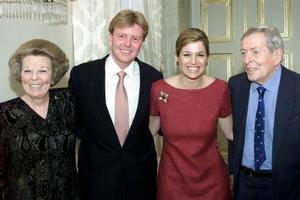
Prince Claus, the German-born husband of Queen Beatrix who employed
wit, charm and patience to overcome Dutch hostility and win the affection
of his adopted nation, died Sunday 6 october 2002. He was 76.
Claus had been in and out of intensive care for several months with
respiratory and heart problems. Doctors at the Academic Medical Center
in Amsterdam said he died of Parkinson's disease and pneumonia, according
to a government statement.
Claus' marriage to Beatrix was initially resisted by the Dutch public,
with many residents upset about his service with the Nazi army in World
War II and membership in the Hitler Youth.
But his eventual acceptance was reflected on her death, when the country's
television and radio stations interrupted regular programming to air
special newscasts and documentaries on Claus' life. The government declared
a period of mourning and instructed public buildings to fly flags at
half-mast until his burial.
In a live televised broadcast, Prime Minister Jan-Peter Balkenende said
Claus' death "comes as a shock to us all, even though we new for years
of his poor health."
"He was a remarkable man who won a warm place in the hearts of the Dutch
people," Balkenende said. "With his passing, a great man is gone."
Dozens of mourners, young and old, streamed to the Huis ten Bosch palace
in The Hague to lay flowers or light candles outside the royal residence.
The prince battled ill health and depression for years, including prostate
surgery in 1998, and the removal of a kidney in May 2001.
Claus' entry into Dutch society despite his past was helped when he
and the queen produced the first male heir to the Dutch throne in nearly
a century. The royal couple had two more sons, Prince Johan Friso and
Prince Constantijn.
Claus won over the Dutch people with his gentle wit and affable manner.
He also made a favorable impression by mastering the Dutch language
and learning to speak it with little trace of an accent.
He took an active interest in Third World affairs, carefully steered
away from controversy, and involved himself in public duties. He was
granted Dutch nationality by a special act of Parliament.
Though born a German aristocrat, Claus showed a humility that appealed
to the unassuming Dutch. In 1997, he asked the public to refrain from
marking his birthday because it coincided with the funeral of Britain's
Princess Diana.
Claus was a low-ranking West German diplomat when he first met Beatrix,
then the crown princess, on a Swiss ski slope during a winter holiday
in February 1965.
Their romance — kept secret until a Dutch news photographer caught them
several months later walking hand in hand — sparked a storm of protest
in the Netherlands.
The match nevertheless had the approval of Queen Juliana; her husband
Prince Bernhard, himself a native German; and the Dutch parliament.
An only child, Claus was born Sept. 6, 1926, in Dotzingen in northern
Germany. Like many German secondary school children from aristocratic
families, he joined the Nazi youth organizations Jungvolk and Hitlerjugend.
After finishing school in 1944, he served with the German army in Denmark
and with the 90th Panzer Division in Italy, but didn't see combat.
He was captured by U.S. forces near Merano, Italy, in 1945 and sent
to a prisoner of war camp at Ghedi, near Brescia. Later he was transferred
to Britain, where he worked as a driver and interpreter.
The Crown Prince Willem-Alexander
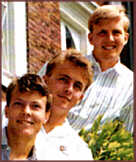 Prince
Willem-Alexander was born on 27 April 1967, the first child of Princess
Beatrix and Prince Claus. The Prince was born in the University Hospital,
Utrecht, and he spent his early childhood at Drakensteyn Castle in Lage
Vuursche. Prince Willem-Alexander has two brothers: Prince Johan Friso
(born in 1968) and Prince Constantijn (born in 1969). Prince
Willem-Alexander was born on 27 April 1967, the first child of Princess
Beatrix and Prince Claus. The Prince was born in the University Hospital,
Utrecht, and he spent his early childhood at Drakensteyn Castle in Lage
Vuursche. Prince Willem-Alexander has two brothers: Prince Johan Friso
(born in 1968) and Prince Constantijn (born in 1969).
On his mother's accession to the throne on 30 April 1980, Prince Willem-Alexander,
as her eldest child, became first in line of succession. As heir to
the throne, he bears the title Prince of Orange, which has been held
by the Sovereign's eldest son since 1815.
In 1995, the Prince of Orange was promoted to the rank of Lieutenant-Commander
in the Royal Naval Reserve, Major in the Royal Netherlands Army, attached
to the Grenadiers and Rifles Guards Regiment, and Squadron Leader in
the Royal Netherlands Air Force. Since 1997, he has held the rank of
Commander in the Royal Naval Reserve, Lieutenant-Colonel in the Royal
Army Reserve, infantry division, and Wing Commander in the Royal Air
Force Reserve. The Prince is also Aide-de-Camp Extraordinary to Her
Majesty the Queen.
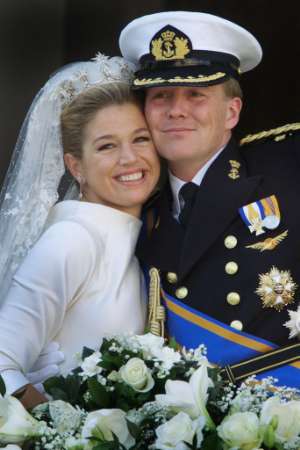
Willem-Alexander and Máxima met eachother in April 1999 in Sevilla,
Spain, at the Feria.
The relation is known in the Netherlands since August 1999 when they
were spotted together on the boat of the Royal Family in the Netherlands.
Willem-Alexander asked Máxima to marry him on January 19th, 2001, at
the pond of Palace Huis ten Bosch near The Hague.
In the photo, Dutch Crown Prince Willem-Alexander cuddles his wife Princess
Maxima as they wave to the crowd from the balcony of the royal palace
after their wedding, February 2, 2002. Some 1,750 guests attended the
wedding of Queen Beatrix´s eldest son and the Argentine-born Maxima
Zorreguieta at Amsterdam´s 600-year-old Nieuwe Kerk church.
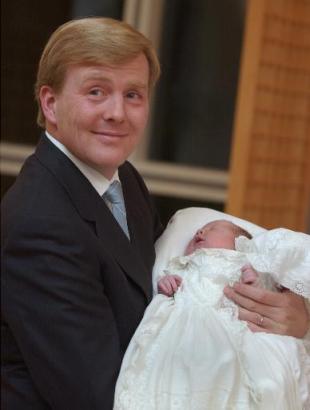
On the 7th of december, was born The Princess Catharina-Amalia Beatrix
Carmen Victoria, Princess of the Netherlands, Princess of Oranje-Nassau
, the future Queen of Netherland after her father the Prince William.

|