CATALONIA
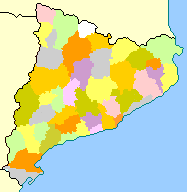

History of Catalonia The present structure of political power in Catalonia was defined basically by the Statute of Autonomy and by the political institutions of the Generalitat de Catalunya. Unlike the institutions of the other Autonomous Communities in Spain, the Generalitat de Catalunya was not created after the adoption of the new Spanish Constitution in 1978, but was restored in 1977 prior to the adoption of the Constitution. The term restored is used not only because the Generalitat de Catalunya had existed in democratic Spain during the Second Republic (1931-1939), but also because the name had first been used to designate the executive body set up by the Corts Generals of the Federation of the Catalan-Aragon Crown (c. 14-15th). The roots of Catalonia as a nation with its own territory and government go back to the early part of the Middle Ages. The progressive emancipation of the Counts of Catalonia from the Frankish kings throughout the 10th and 11th centuries, the conquest of new territories wrested from the Saracens and the ensuing repopulation of this area with Catalan-speakers, together with the supremacy of the Counts of Barcelona (Ramon Berenguer III and Ramon Berenguer IV) were all decisive factors in the long process of Catalan unification. This process led to the establishment of Barcelona as the capital city, the consolidation of a unified government over the Catalan counties, and the implantation of the country's own language. The heads of the House of Barcelona were to govern the Catalan people for the better part of five centuries. Throughout the centuries, the Catalan nation has had various political institutions and forms of government, each one appropriate to its time, with varying degrees of sovereignty. During certain periods, these institutions corresponded to the existence of a sovereign state, while at other more recent times they have represented a sharing of power with the central Spanish state. With the marriage of Count Ramon Berenguer IV to Petronila of Aragon in 1137, the Kingdom of Catalonia and Aragon was born. In addition to these two territories, together with Provence and Roussillon, this kingdom was to successively incorporate the Balearic Islands, Valencia, Sicily, Corsica, Sardinia and Naples, and ultimately extended as far as Athens and Neopatria. The progressive consolidation of the territory and government of Catalonia due to the course of events during that period culminated in the establishment of a legitimate title. By virtue of the Treaty of Corbeil (1258) between James I the Conqueror and Louis IX (Saint Louis of France), the former agreed to the loss of his dominions beyond the Pyrenees (except Montpellier and Roussillon), while the King of France as the successor to the Carolingian kings renounced his rights to the Catalan provinces of Barcelona, Urgell, Besalú, Roussillon, Empúries, Cerdanya, Conflent, Girona and Osona. Catalonia lost territory but gained legitimate independence. Indeed, actual independence dates from 989. The Catalan-Aragon dynasty came to an end in the early 15th century. The throne passed successively to Castilian (Trastámara), French (Bourbon) and Austrian (Hapsburg) dynasties. But the lands under the Catalan-Aragon crown, as of the 14th century, could count on a political and administrative body which emerged from the Corts Reials, the Generalitat, which was to become a government institution. This institution, which underwent a series of vicissitudes over the course of time, was the forerunner of today's political institutions in Catalonia. Although it is true that the exercise of power in the Middle Ages had little in common with the distribution of power in a modern democratic state, it is nonetheless significant that the Generalitat is the only institution of self-rule which has expressed the political power of Catalonia throughout the centuries, and that it has endured to the present day. The exercise of their rights and liberties and the authority of their institutions were interrupted against the will of the people for long stretches of time throughout the history of Catalonia. However, Catalonia has always managed to regain control of its own destiny, especially when at decisive moments its citizens have demonstrated their unified support of their political institutions. |
