 Queen Elizabeth II of Great Britain Queen Elizabeth II of Great BritainHow can one describe - so that others may understand it - the European monarchy of today? How can one explain that a modern state can maintain such an "antiquated" system? In attempting to find an answer we must turn to history, because traditions - as they are learned and perceived - create attitudes, which in turn lead to actions. However, it is the current system we are dealing with here, and not primarily the events leading up to it. This provided the system with an ideological basis which it has subsequently retained. It was rooted neither in an existing nobility nor a divinity. It was adopted by representatives of the people, and thus gained legitimacy - also by the standards of the time. The manner in which this somewhat diffuse term, legitimacy, was to be given substance, and the monarchy provided with a deeper rooting, was a core issue during subsequent decades. 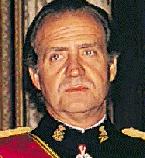 King Juan Carlos of Spain King Juan Carlos of SpainNevertheless, the function of the monarch in this system is many-sided. In situations where he has no real or formal power, he can still exert influence. Though he makes no decisions, his pronouncements may still carry weight. Whatever he wishes to leave unchanged, he can preserve through tradition. Every system of monarchy contains loopholes; these can be exploited by the monarch - in accordance with his capabilities and wishes. In this perspective the requirements to the monarchy, and the attitudes of the monarch become one and the same. Or, one could say that the function of the system is dependent upon the practice of the role. "The King" is synonymous with the government. But the institution is shaped by the person, by the king, not the King. 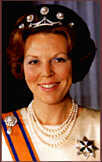 Queen Beatrix of Nederland Queen Beatrix of Nederland"Royal research" is a neglected field in Europe. But the main pattern can be outlined. This is apparent in three different situations, historically and contemporarily: in everyday life, at changes of government, and during national crises. The day-to-day role of the head of state in a modern monarchy is primarily of a symbolic nature. He represents his state and people. He is the master of ceremonies par excellence. He is above the people in rank and dignity, and has neither the right to vote nor obligation to pay taxes. The fact that he chooses his personal acquaintances from a narrow social circle does not weaken this image. The European system does not allow a politicking "court". 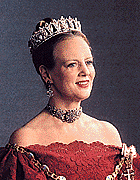 Queen Margaret II of Denmark Queen Margaret II of DenmarkThus, the mission of the monarch is to fulfil everyday assignments. When a government rules, the king provides the necessary endorsements. When he addresses to their people at sea, makes a declaration on the status of the realm at New Year, he is the king of our childhood fairy tales, the father of his people. The king has been given his due: from a political viewpoint he is the powerless head of a democratic state. But the people have also been given their due. Situations like this enforce upon the king the role of a political participant. With numerous small parties and continued minority governments, several fragile political constellations may appear in the future. These serve to illustrate the interdependence of system and person. 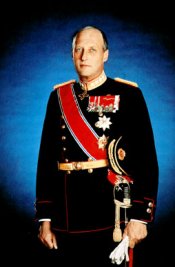 King Harald V of Norway King Harald V of NorwayNational crises are less frequent. In these the king can scarcely avoid a central role. During the war and the occupation more Kings role was diverse; as a participant in continuing processes, and as a symbol of national unity. His resounding "No" to the German/Quisling demands on 1940 stands sharply illuminated in the history of the monarchy and the country. His statement to the government was: "The decision is yours. But if you choose to accept the German demands, I must abdicate. For I cannot appoint Quisling as prime minister" say the King Olaf of Norway With the liberation in 1945 the last elements in this development were cemented into place. The transition to a reconstructed political system was a painless one, surprisingly painless given the preceding five years of turbulence. But the most automatic process of all was the resumption of the functions of the monarch and the monarchy.  Prince Rainiero III of Monaco Prince Rainiero III of MonacoThe democratization of the monarchy has increased some, not least via the queen's "commoner" origins, but also via the media's general curiosity about the private lives of the Royal Family, the cost of remodelling the Palace and hints of a new balance in the monarchy's relationship to private enterprise. The personal opinions of the Crown Prince, the coming head of state, are interesting. Are they a sign of coming nuances in his understanding of his role? So there are some new directions, but nothing so far that would indicate a break with the continuity which for almost a century has characterized the European monarchy. It rests on a legal basis: in both the written and the unwritten constitution. It has a political anchorage; in that the state system is elevated above the day-to-day political struggle. But neither of these anchorages would prove safe in a storm without additional security. This is found in the legitimacy that the monarchy has gained among the people. This is perhaps a rather elusive term. But it represents the attitude of the people towards the system, the acceptance of the system's representatives by those they represent, the hopes the people invest in those who fill the various roles, and the manner in which these expectations are met.  Royal Family of Liechtenstein Royal Family of LiechtensteinAll the same, one may well ask, and in other countries the question is often posed, how a modern state can still retain a form of government that in a world perspective belongs in a museum? There is only partial substance in this question. A form of government which has functioned for so long is only antiquated in the eyes of those who do not understand it. But if it is taken seriously, the answer is implicit in what I have said. This form of government has not been any impediment to the development of a modern society and to the nation's political possibility of choosing its own path. Conditions have been favourable for the growth of democracy. The monarchy has been a framework, not a brake. It has undergone a process of democratization of at least the same magnitude as the "monarchization" of the democracy. 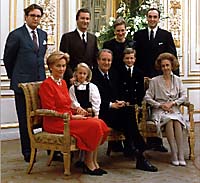 Royal Family of Belgium Royal Family of BelgiumHowever, a specific form of government does not only survive because it does not apply the brakes. Has the monarchy functioned in a democratically functional way?. What have been the positive effects of maintaining an outer framework which may seem old fashioned?. This is a natural point at which to emphasize how the division at the top of the system is limited both politically and functionally. Therefore the position of head of State is elevated above conflict, but that of head of government implies power, and is therefore controversial. The normal democratic conflicts of groups and political parties follow their usual course. The traditions that are a part of the form of government automatically channel them in the right direction, in keeping with their goals of jockeying for a favourable position. But at the very top, far from all sounds of strife, some element, at least, in this quarrelsome people, has been neutralized, subdued and made sacrosanct. 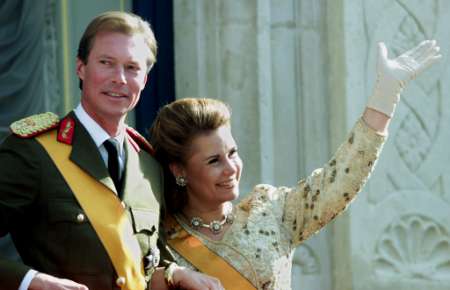 Grand Duke Henry Grand Duke HenryIt is at this level that the monarch can play the role of father, of the king in fairy tales, who fulfils our common need for fantasies and also for identification. He can symbolize unity in the midst of political confusion, be the focal point, far removed from sector interests. This is of course a mystical, indeed a mythical thing and to modern eyes undoubtedly a relic of the past. But how blind are those who have completely lost their sense of the irrational! Is the monarchy, perhaps, a purely conservative element - linked as it is to the church, to the military, to the solid pillars of the establishment ? Certainly it is. But no more so than any other system which is loyally adhered to. It has never been reactionary and is still not so. Other factors have shaped our society: technology and industrialization, primary and secondary industries, oil in the North Sea and security policy; the monarchical system of government has served neither as a brake nor a locomotive force.  Royal Family of Sweden Royal Family of SwedenSweden Crown copyright The overall significance of the monarchy is not easy to describe. The personal role of the monarch is equally difficult to understand. Only if the monarchy were to fall would its full significance be clearly revealed. Photographs copyright of the respective Royal Houses
|

